


How to Sell a Mobile Home on Private Property
You want to buy or sell a manufactured home and remove it from private property in Oregon but you’re not sure how to complete the paperwork on your own. In this article I’m going to explain, step-by-step, how to sell your manufactured home in Oregon, without the land, and remove it from private property in Oregon.
Selling a manufactured home is more like selling a car than selling real estate. In fact, it was the DMV who used to keep track of the titles of manufactured homes in Oregon, not anymore. Starting May 1, 2005, the Oregon Building Codes Division (“BCD”) now keeps track of these titles (actually, they’re called “Ownership Documents” now, not titles). All forms needed to transfer ownership can be found at their website, here.
If you use a realtor to buy/sell a mobile/manufactured home, the realtor and the title company will handle this paperwork. However, it costs roughly $1,000 for each buyer and seller to do this. And, unlike traditional real estate transactions, title companies in Oregon do not issue title insurance for mobile/manufactured homes. All you’re paying for is for them to organize the paperwork and act as a neutral 3rd party where each side can feel protected exchanging the money for the ownership document.
For transactions with a large dollar amount, this might be worth it. However, if the transaction is not a big dollar amount, it would seem silly to pay an extra $1,000 per person to consummate the transaction. Sometimes, this might be more than the transaction itself. Below is a step-by-step process of how to do this yourself if you find yourself in that situation.
STEP 1 – BILL OF SALE
Once you find a willing seller (or buyer), you’ll want to write up a contract that outlines the price and terms of the agreement. There isn’t a standard bill of sale, so to speak, but there are a few key terms you’ll want to include (this is not legal advice):
Parties
You’ll need to identify the Buyer(s) and Seller(s). An example of this would be:
This contract (the “Contract”), dated __________, in which Buyer, _____________________, offers to purchase from Seller(s), __________________, the following described manufactured home (“Property”):
Address/Home ID/Park
You’ll need to identify what is being sold. While the home is being sold without the land, the key identifier of what is being sold is the Home ID (as shown on the Ownership Document), the Address of where the home currently sits. An example of this might look like this:
Address: 123 Main St
Home ID: 261457


Price
You should have both (1) the purchase price, and (2) how that purchase price will be paid. Is the buyer going to be paying earnest money? Are they paying the seller all the money at closing? All of this is negotiable between the buyer and seller. An example of what a price term might say is:
The purchase price is to be $4,000, payable in the following manner:
$500 refundable earnest money paid within 2 business days of signing this Contract;
The remaining $3,500 paid in cash at closing
Items to be included & excluded from the home
Because the buyer is only buying the home, and the seller owns the land, the home will need to be removed from the seller’s land. This means anything attached to the home that isn’t coming with the home will be left behind. The buyer will want to make clear which things will be staying behind. Otherwise, the buyer will be responsible for clearing those items from the land after the home is moved. Below is an example of what such a clause would look like:
The following items to be excluded from the Property to be purchased: all exterior decking attached to the Property, any awnings, carports, and all foundation materials (including all skirting). Seller to remove attached decking, attached awnings, attached carports, skirting, and any other improvements, trees, and/or landscaping or fencing need to effectively remove the Property from the Premises. If the Property is “Pit-Set,” Seller to excavate around the foundation to create graded ground to allow for home removal.
Inspection Period
It’s customary in any contract to be able to “look under the hood” of what the buyer is buying before closing. This is usually called the Inspection Period (or Due Diligence Period). This allows the Buyer to inspect the home to make sure there are no other defects they weren’t aware of before closing. An example of what the Inspection clause might say is:
This Agreement is subject to the final inspection and approval of the Property (“Inspection Period”) by the buyer on or before X business days from the signing of this Contract. If the Buyer, for any reason, is unsatisfied with the inspection, the Buyer, with written notification to the Seller, can terminate the contract without penalty.
Closing & Removal Date
You’ll need to agree in writing when the closing will happen AND when the removal of the home will happen. When will the buyer give the seller the remaining purchase price, when will the seller sign over ownership to the buyer, and when will the home be removed from the land. An example of what this may look like is below:
Closing date shall be on or before 10 days prior to the removal date. Removal Date shall be 120 days after the dual execution of this agreement. Home must be road worthy of transport.

STEP 2 – PLACEMENT PERMIT
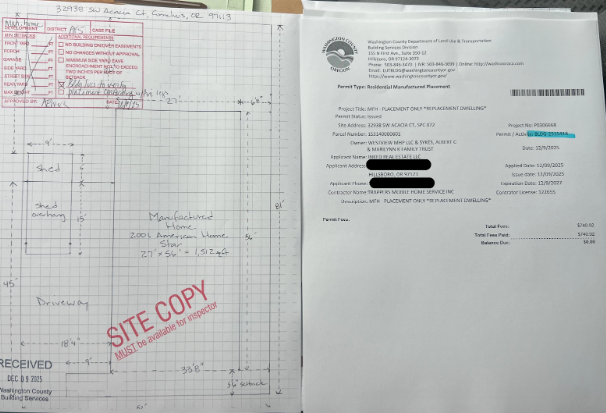
In order to place the home at the new location, the buyer will need to get approval from the county. This approval comes in the form of a placement permit. Every city/county is different in what they want to see to approve your placement permit. For all properties outside the urban growth boundary, you’ll be dealing with the county. Usually, the county will only ask for a site map and their application to be completed. The site map should look exactly like the site map required for the demo permit. The buyer should get this started before closing on the home and transferring ownership. Otherwise, if the county won’t allow the home to be placed in the location the buyer desires, the buyer will want to rescind the contract.
Here is an example of a placement permit we obtained for a property
STEP 3 – FORM 2952 ($55) + TRIP PERMIT ($5-10)
After the buyer is satisfied with their inspection, Form 2952 needs to be completed. You can download the form for free, but the cost of turning in the form once complete is $55. In addition, because the home is being moved, the buyer will need to obtain a trip permit, which costs $5 per home section ($10 for a double wide because there are 2 sections). Below are pictures and explanations on how to complete this form. If you have questions, please contact the Oregon Building Codes Division and they will walk you through how to fill out each page.
Page 1
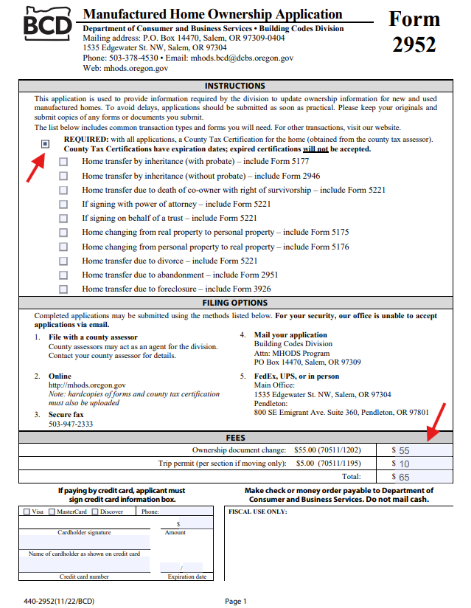
Page 1 is basically the cover sheet. You’ll need to check the box under the “Instructions” section next to the word, “REQUIRED” to acknowledge you understand a tax certification is required to successfully file this form (more on that in Step 4 below). In addition, at the bottom, you’ll need to write $55 in the “ownership document change” column, $5-10 in the trip permit section (for this example, we’ll move a double-wide) and the total ($65) in the “total column”.
Page 2
Section 1 – Nature of Filing. For our example, you’ll select “Used home sale” AND “Trip Permit” since we’re moving the home.

Section 2 – Applicant Information. This is the section for the applicant, the person filing the form. This can be anyone listed here. In this example, we’re going to say the applicant is the Buyer.

Section 3 – Home Information. This is the home information section. You’ll get this information from the Ownership Document, which can be found at https://aca-oregon.accela/com/or_mhods/default.aspx. Here is an example of what an ownership document looks like:
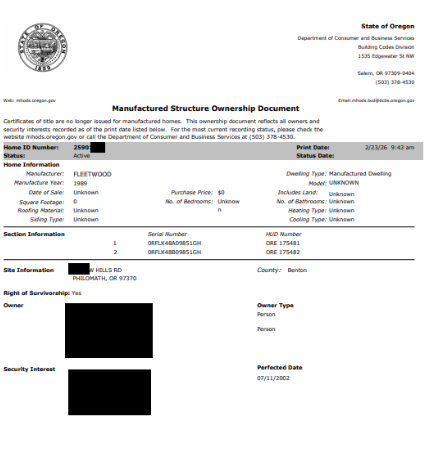
And here is how you’d fill out section 3:
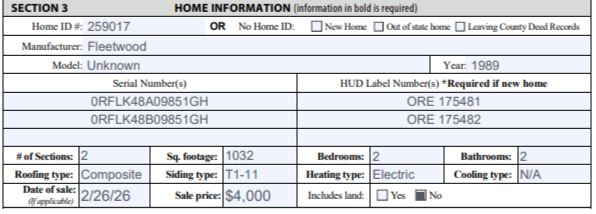
Notice how this doesn’t have to exactly match the ownership document currently on file. Sometimes there is incomplete information on these forms and you’ll need to take measurements and fill-in the blanks. They’re getting more strict on these forms recently and will want to see most of this filled out – although each clerk is different.
There are two serial numbers because this home is a double-wide, one serial number per section. The date of sale is something that you won’t pull from the existing ownership document, this date of sale is for when the seller/buyer close on the current transaction. Similarly, the sale price is not pulled from the ownership document, as that price was the price the seller bought at previously. The sale price you’ll want to put here is the sale price located on the bill of sale. For this example we’ll keep it at $4,000.
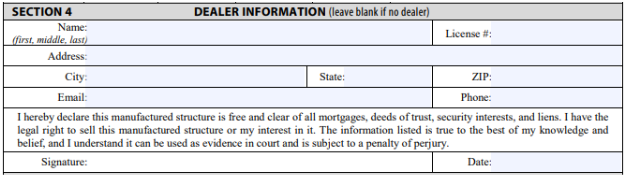
Section 4 – Dealers. This section is only for dealers. Disregard.
Section 5 – Home Location.
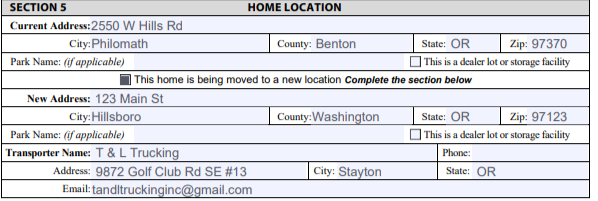
This is the location where the home is currently located. This can also be found on the bill of sale if you identified the home to be sold. Because this home is being moved, you’ll need to complete the bottom portion, both the location where the home is being moved and the transporter information. T & L Trucking in Stayton is a transport company we use regularly, they’re fairly priced, honest, and reliable.
Page 3
Section 6 – New Owner Acknowledgement.
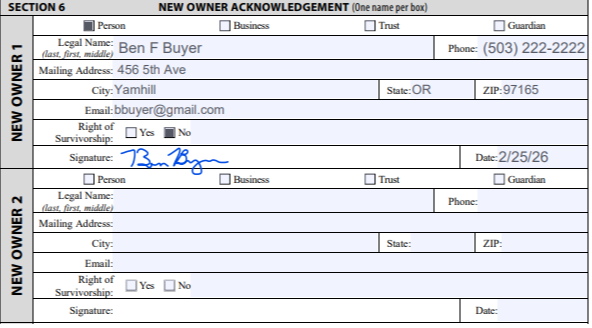
Section 6 – New Owner Acknowledgement. This is the section where the new owner(s) complete. Right of Survivorship means that if one of the owner(s) pass away, ownership of the home automatically transfers to the other owner(s), without the need to go through probate. This is often checked “yes” for husband and wife owners, but doesn’t have to be. Because, in this example, there is only one buyer, there cannot be a right of survivorship.
Page 4
Section 7 – Security Interest Holders.
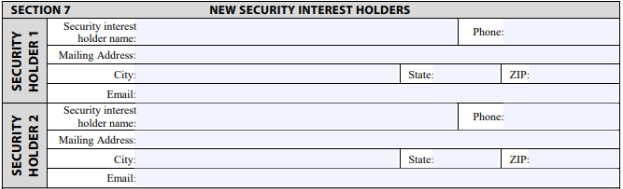
If the buyer were to purchase the home with a mortgage, the bank would be listed here as a security interest holder. If the seller were to sell to the buyer and hold a note (accept monthly payments as part of the purchase price), the seller would put their name here. For this example, we’re assuming the buyer bought this money with their own cash, so we leave this blank.
Section 8 – Current Owner Acknowledgement.
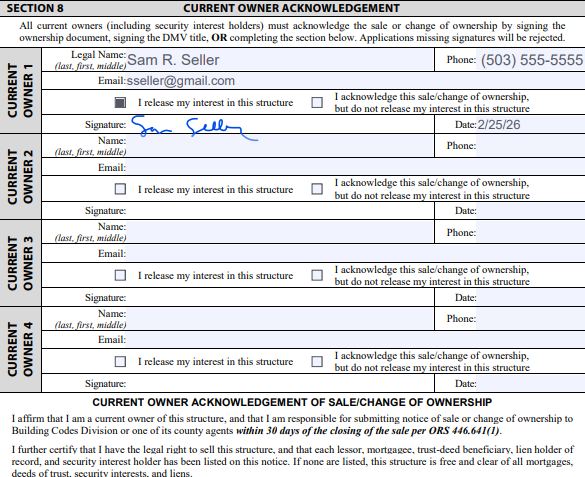
This section is for the seller(s) to complete. Make sure the seller checks the box saying, “I release my interest in this structure”.

Security Holder Release.
This last section on the last page is for current security interest holders to sign-off that they’ve been paid in full for the amount they lent to the seller(s) in the previous sale. If there is a lien against the house, of any kind, the transaction can’t record until this is filled out. The bank for the mortgage on the house is the party that would usually complete this section. In our example, there is no mortgage on the house so we leave this empty.
STEP 4 – VALID COUNTY TAX CERTIFICATION ($16)
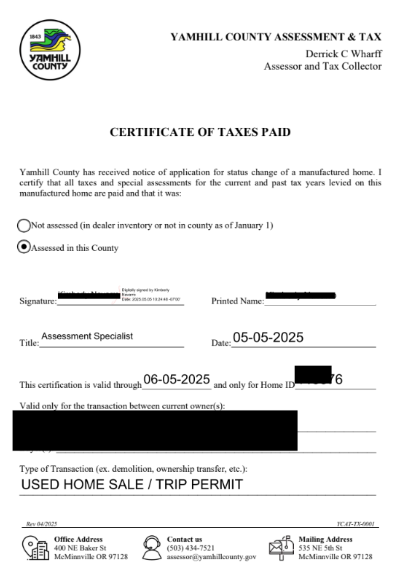
Once Form 2952 is complete with signatures, you’ll need to take that form to the County Tax Assessor’s Office where the home is currently located. You’ll need to obtain a valid county tax certification that shows there are no taxes owed on the home before they’ll allow you to transfer ownership. If there are taxes owed, this would need to be paid before they issue the tax certification.
The County won’t give you a valid county tax certification without a completed Form 2952. You can either walk into the county tax assessor’s office to get this or you can email them (make sure to have/email your Form 2952). This will cost you $16. Here is a picture of what a valid county tax certification looks like:
STEP 5 – SUBMIT FORM 2952 + COUNTY TAX CERTIFICATION
Once you have both Form 2952 completed and a valid County Tax Certification that shows no taxes are owed on the home, you need to submit both forms. If your Form 2952 has the wet signatures, you can simply turn these into the County Tax Assessor’s office, the same office you received the Valid County Tax Certification. They’ll submit them to the Oregon Building Codes Division for you and email you once they’ve been successfully recorded. If you don’t have the wet signatures on Form 2952, the County will give you the Tax Certification but you’ll need to submit those yourself to the Building Codes Division in Salem at 1535 Edgewater St NW, Salem, OR 97304, in person or via mail. Or, you could submit them online at MHODS (Manufactured Home Ownership Document System). You’ll need to create an account and upload the docs yourself.

STEP 6 – DEMO PERMIT
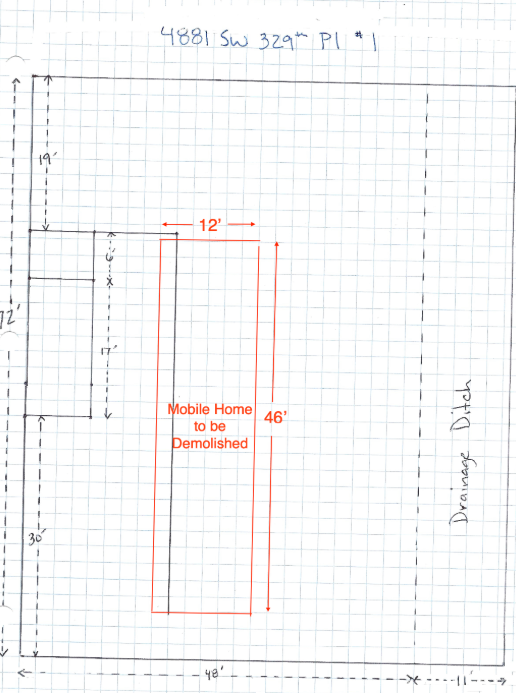
You’ll need to get a demo permit, even though the home is not being demolished. The county will want a demo permit even for removing the home from the property. This is something the seller should obtain, and should be obtained a little before the break-down of the home. In Washington County, this usually takes 2-3 weeks. You’ll need a site map of the property – nothing too formal, just showing the boundary lines of the property and the footprint of the home. Here is a copy of the one we just submitted:
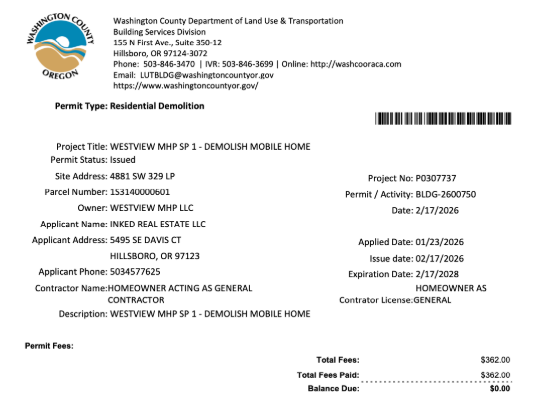
Below is a copy of a demolition permit that we obtained from Washington County. The fee is based on the cost of the removal. In our case, I put the cost of the break-down (see below).
All-in, we paid $233 for the demo permit (usually the seller pays this, but we at Inked Real Estate usually pay this for the seller).
STEP 7 – BREAK-DOWN
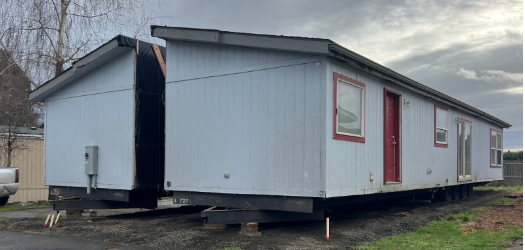
Before transport, the buyer will need to “break-down” the home. This includes cutting the home in two (or three – if the home is a double-wide or triple-wide). For all homes (single-wide included), the buyer will need to fasten everything down (all loose fixtures, kitchen cabinets, appliances,etc.), disconnect all sewer/plumbing, and detach all electrical from the home (we always encourage sellers to call their electricity provider to make sure they don’t want to come to the home and take any equipment that may be theirs). In addition, they’ll weld the tongues on the steel frame of the home (hopefully those are under the house from the last move) for the transport company so they can just hook their hitch on the tongues and move it.
For this service, I use a company called Trappers Mobile Home Service Inc. A guy named Dave Newman owns it and he’s been breaking down homes for over 30 years. He’s reasonably priced, honest, and reliable. The average break-down rate (as of the date of this article) for the following sizes of homes is:
- Single-Wide: $2,900
- Double-Wide: $6,500
- Triple-Wide: $9,000
STEP 8 – TRANSPORT
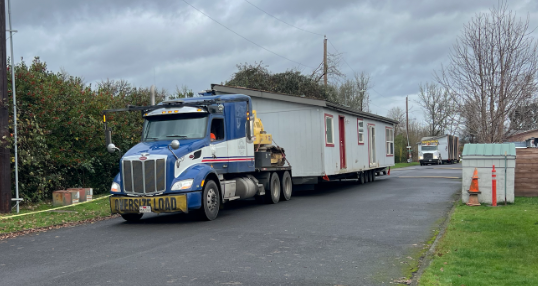
After the home is broken-down, the home is ready for the freight company to transport. This is a pretty straightforward process. The freight company will hook the hitch to the tongues that were welded to the frame by the break-down crew. Costs for moving a home can vary greatly, due to the size of the home (single-wide, double-wide, or triple-wide) and the distance the transport has to travel. To give you an idea of how much transport costs, I moved a double-wide (2 sections) from Rickreall, OR to Cornelius, OR (58 miles) and paid the transport crew $5,100.
STEP 9 – SETUP
Ok, the home is moved to the new location and now needs to be set back up. For single wides, this is relatively simple. You’ll need to get ¾” minus gravel delivered that measures 6” high and spans the footprint of the home plus 3 inches on each side. Then you’ll need to pack the gravel, which can be done easily simply by driving a truck over the gravel a few times. The setup crew (often the same crew as the break-down crew) will put the house on blocks and hook-up all the utilities.
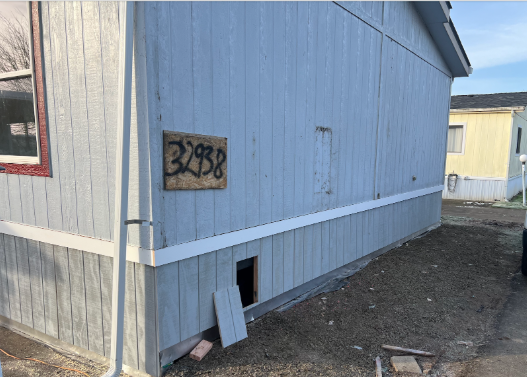
In addition to the gravel, you’ll need to add skirting to the home for the placement permit to be finalized. You’ll need to call a licensed skirting installer (LSI). These people can be found on the Oregon Building Codes website. You’ll want to check the box, “RV and manuf dwellings,” then scroll down to the licensees that either say LSI (Licensed Skirting Installer) or MDI (Manufactured Dwelling Installer). The cost for the skirting varies greatly, from the size of the home to the material you choose to use. Recently, we paid $5,500 for T1-11 skirting on a 28’ x 56’ double-wide. Aluminum skirting will be considerably less expensive.
Conclusion
And that explains the process of how to sell a mobile or manufactured home in Oregon when it needs to be removed from private property. Other paperwork would be needed for certain unique situations, selling homes in trusts/probate, selling homes with a right of survivorship where one party is deceased, etc… Forms that handle all of those situations can be found here. Please be aware, none of this is legal advice. If you are unsure if your specific situation warrants other paperwork to complete, please contact a real estate agent, the Oregon Building Codes Division, or an attorney.
All-in, to sell a manufactured home on private property in Oregon, the sellers expenses and the buyers expenses are vastly different. The seller doesn’t have many expenses, the buyer has many. Below is a list of typical expenses for the Seller:
- Demo Permit
- Skirting/Decking Removal
- Pit-Set Dig-out
Below is a list of typical expenses for the buyer:
- Form 2952
- Trip Permit
- Valid Tax Certification
- Placement Permit
- Break-Down
- Transport
- Setup
- Gravel
- Skirting
If you have a mobile or manufactured home you’re looking to sell or buy, or are just curious about how this all works, feel free to contact us and we’ll gladly explain the process and answer any of your questions.
Good luck!
Frequently Asked Questions
Related

What’s the difference between mobile home removal and mobile home demolition in Oregon?
When people search how to remove a mobile home, they’re usually deciding between two very different removal methods: relocation or demolition. The right option depends on the condition of the mobile home, local regulations, and whether the structure will be reused.
Mobile home removal typically means disconnecting utilities, securing a moving permit, transporting the trailer, and setting it up at a new site. This option applies when the mobile home or manufactured home is structurally sound and road worthy. In this case, the removal process involves utility disconnection, break-down, transport, and reinstallation—not destruction.
Mobile home demolition, on the other hand, applies when the old mobile home is no longer salvageable. This demolition process involves tearing down the structure, separating salvageable material, managing debris, and coordinating proper disposal through approved waste management channels. A licensed contractor may handle professional mobile home demolition, including debris removal, dumpsters, and final site grading.
Unlike house demolition, a mobile home demolition may require additional attention to hazardous materials in older mobile homes. Some older mobile homes contain materials that require specialized disposal. The fire department may also require written notice before large-scale demolition begins.
In Oregon, removal almost always requires a necessary permit, and in many counties you’ll need required permits even if you are simply relocating the trailer rather than performing demolition. Always verify regulation requirements with your county planning department before starting the demolition process or removal process.
How much does mobile home demolition cost and what factors affect pricing?
Demolition cost varies significantly depending on size, location, and site conditions. In Oregon, pricing is typically calculated by square foot, accessibility, and complexity of debris disposal.
Key cost factors include:
- Size of the mobile home (single-wide, double-wide, triple-wide)
- Whether concrete removal is required (slab, skirting footings, foundation)
- Utility disconnection requirements
- Volume of debris and dumpsters needed
- Distance to disposal facilities
- Local regulation and permit requirements
- Whether tank removal (such as septic or fuel tanks) is necessary
- Any interior demolition needed prior to full teardown
Professional mobile home demolition generally includes labor, equipment, debris removal, and waste management coordination. If you’re dealing with an estate cleanout, junk removal may be required before demolition begins. That can increase total cost if the old mobile home contains personal property or debris inside.
In some situations, deconstruction rather than full mechanical demolition may reduce disposal costs because salvageable material—such as metal framing—can be recycled. However, this approach requires more labor.
Every service area within Oregon may price differently due to landfill fees and urban development density. Rural counties may have lower fees, while metro areas often have stricter local regulations and higher disposal costs.
What permits are required to remove or demolish a mobile home in Oregon?
If you’re researching how to remove a mobile home, understanding permits is critical. Oregon does not treat a mobile home like a typical motor vehicle anymore. Ownership transfers through the Oregon Building Codes Division, and removal requires specific paperwork.
Depending on your situation, you may need:
- A moving permit (if relocating the trailer)
- A demolition permit (even if the structure isn’t being destroyed but removed)
- Required permits from the county planning department
- Written notice to utility providers for utility disconnection
- Clearance showing no lien exists on the home
- Tax certification before ownership transfer
If you are demolishing the structure entirely, counties often require documentation confirming proper disposal of debris and compliance with regulation standards.
If the mobile home has a security interest holder or lien, that must be resolved before removal or demolition can proceed. Additionally, removal tied to urban development projects may trigger additional regulation oversight.
Keep in mind: permit requirements differ widely by state. For example, North Carolina and South Carolina have their own removal process and required permits that differ from Oregon’s system. Always confirm with your local county office.
When should I relocate an old mobile home instead of demolishing it?
Not every old mobile home should be demolished. If the structure is road worthy and structurally intact, relocation may be more economical than full demolition and disposal.
Relocation is typically appropriate when:
- The mobile home can pass inspection
- The frame and trailer structure are intact
- A placement permit is approved at the new location
- The cost of transport is less than demolition cost
However, older mobile homes sometimes present issues such as structural fatigue, outdated wiring, or hazardous materials. In these cases, mobile home demolition may be safer.
Removal methods depend on condition. For a relocatable mobile home, an experienced team will:
- Complete utility disconnection
- Perform structural separation for multi-section units
- Secure transport equipment
- Coordinate proper permit filings
If demolition is chosen, the demolition process may include:
- Interior demolition to remove fixtures
- Heavy equipment teardown
- Debris separation
- Disposal at approved facilities
- Concrete removal and site restoration
If additional structures exist on-site—such as sheds, pool removal needs, or miscellaneous demolition structures—those may require separate permits.
Some property owners compare mobile home demolition to house demolition, but mobile homes often involve unique documentation due to ownership records and transport requirements.
Before deciding, review popular articles on relocation vs demolition and consult your county building office. Whether you choose mobile home removal or full demolition, understanding the legal and logistical removal process protects you from costly mistakes.